
Introducing PYX Labs: How Good Is AI, Really, at Understanding People at Work?

Key Takeaways: AI is already part of how organizations interpret employee feedback and make decisions about people — that's the new normal, and PYX Labs was founded to help. We define what "good" looks like when AI is applied to understanding humans at work. Our first benchmark, PYX-Voice, evaluated seven frontier models across 84 real employee-experience tasks, each scored against 208 criteria defined by experts. The patterns were consistent: models are far stronger on quantitative questions than on interpretation, no single model is reliable across every topic, and they don't always reason as carefully as they communicate. Knowing exactly where each model is strong and weak is what lets organizations focus their post-training, prompting, and guardrails where it counts. This is the first benchmark of many, and it marks the start of a new discipline: expert post-training and evaluation for workplace AI.
Every day, millions of people open ChatGPT, Claude, or Copilot and ask them to do deeply human work. Summarize what my team is really feeling. Help me coach an underperforming employee. Draft the action plans from our employee engagement survey. Tell me what to say — and what not to say — in a difficult conversation.
We have spent over two decades at Perceptyx helping the world's largest and most respected organizations create thriving employee experiences. So we find ourselves asking a new question: how good is AI, actually, at this?
The honest answer, until now, has been that nobody really knows. AI in the workplace is the new normal — so rather than guess, we built PYX Labs to measure it and help make it better.
What Problem Is PYX Labs Solving?
For the objective corners of knowledge work, we have many ways to measure AI. There are public benchmarks in areas like math and coding — and a frontier model's strengths and weaknesses on those tasks are understood and openly contested.
For the work that touches employees directly, there is no such yardstick. How good is AI at understanding how people feel at work? At guiding a manager through a performance conversation? At spotting what not to say during coaching? Because that work is subjective, "good" is far harder to define — and far less understood.
That mismatch is the opportunity. AI adoption has moved faster than evaluation in the enterprise. Organizations are applying AI to nuanced, people-centered work, and the stakes are higher than in casual use — these outputs can inform real decisions about teams and culture. The more clearly we can see where AI is reliable and where it needs support, the better organizations can put it to work.
PYX Labs exists to close that gap. Put simply: we help the world understand how good AI really is at analyzing human behavior at work — and by understanding it, we help make AI better for the humans at work.
Why Hasn't Anyone Built This Yet?
Because doing it credibly requires three things in one place.
- Vertical expertise. The I/O psychologists, PhDs, and practitioners who apply behavioral science to real workplaces every day — the people who actually know what a great answer to an employee-experience question looks like.
- Technical ability. An in-house team of AI engineers who wake up every day building and running agents and evaluations in these real workplace use cases.
- The data. Twenty years of working with real employee-experience data, across industries, roles, and geographies.
Because these benchmarks are subjective, you need all three to form a defensible point of view. Only PYX Labs has all three under one roof.
This is the part that matters most. Anyone can hand a model a spreadsheet of survey data; the hard, valuable part is defining what separates an excellent answer from a mediocre one — and then encoding that judgment into rubrics a machine can grade. Is the recommendation grounded in the actual data? Is it built on trusted behavioral science rather than management fads? Does it handle sensitive comments responsibly? Does it read like something an executive would actually act on? Answering those questions consistently and defensibly is the unique value behind this work.
A View From Stanford HAI
From Melissa Valentine:
My research at Stanford examines how AI and algorithms are reshaping work and organizations — how teams form around new technologies, and how companies build genuine capability rather than just adopting tools. A recurring lesson is that the technology is rarely the hard part. The hard part is human judgment: deciding what the system is for, what a good outcome looks like, and who has the standing to define it.
That is exactly why PYX Labs' approach is distinctive. Most AI benchmarks measure whether a model can complete a task. This work asks a harder and more important question: whether the model is applying the right values and expertise when it does. The workplace is one of the most consequential domains for AI to get right — it shapes careers, livelihoods, and trust between people and the institutions they work for. Moving the field from raw capability to genuine trustworthiness requires the kind of domain rigor PYX Labs is bringing here, and it's why I'm glad to be advising and contributing to it.
What We Found
Our first benchmark, PYX-Voice, focused on employee listening. It evaluated seven frontier models from Anthropic, Google, OpenAI, and xAI across 84 tasks drawn from real employee-experience work, each scored against criteria defined by experts in employee listening and organizational behavior — 208 in all.
A few findings stand out.
Models handle the math better than the meaning. On quantitative tasks with a clear right answer, the field clustered tightly (76% to 82%). On interpretive tasks — reading open-ended employee comments, identifying the real themes, and turning them into something an executive could act on — scores fell to a 33% to 66% range, and the gap between models widened. Pulling the right number is the comparatively easy part. Interpreting it the way an expert would is where models fall short — which also happens to be the more human, higher-stakes part of the work.
It's not about good or bad — it's about where. No single model dominated. The top overall score was 76%, but that same leading model swung from 0.33 on one workplace topic to a perfect 1.00 on another. Models performed strongest on employee experience topics where feedback is expressed using consistent language and can be readily categorized into well-defined themes. For example, employee feedback related to Performance Enablement typically has very clear, consistent terminology (e.g., goals, resources, tools, success metrics) that easily maps to this category. In contrast, employee feedback related to Change & Innovation can be broad, complex, and nuanced, reflecting not only an employee's personal experience of a particular organizational change, but also their unique human reaction to that change. A seasoned human consultant would be able to interpret and categorize feedback relevant to this topic, whereas LLMs may need more guidance and context to do so.
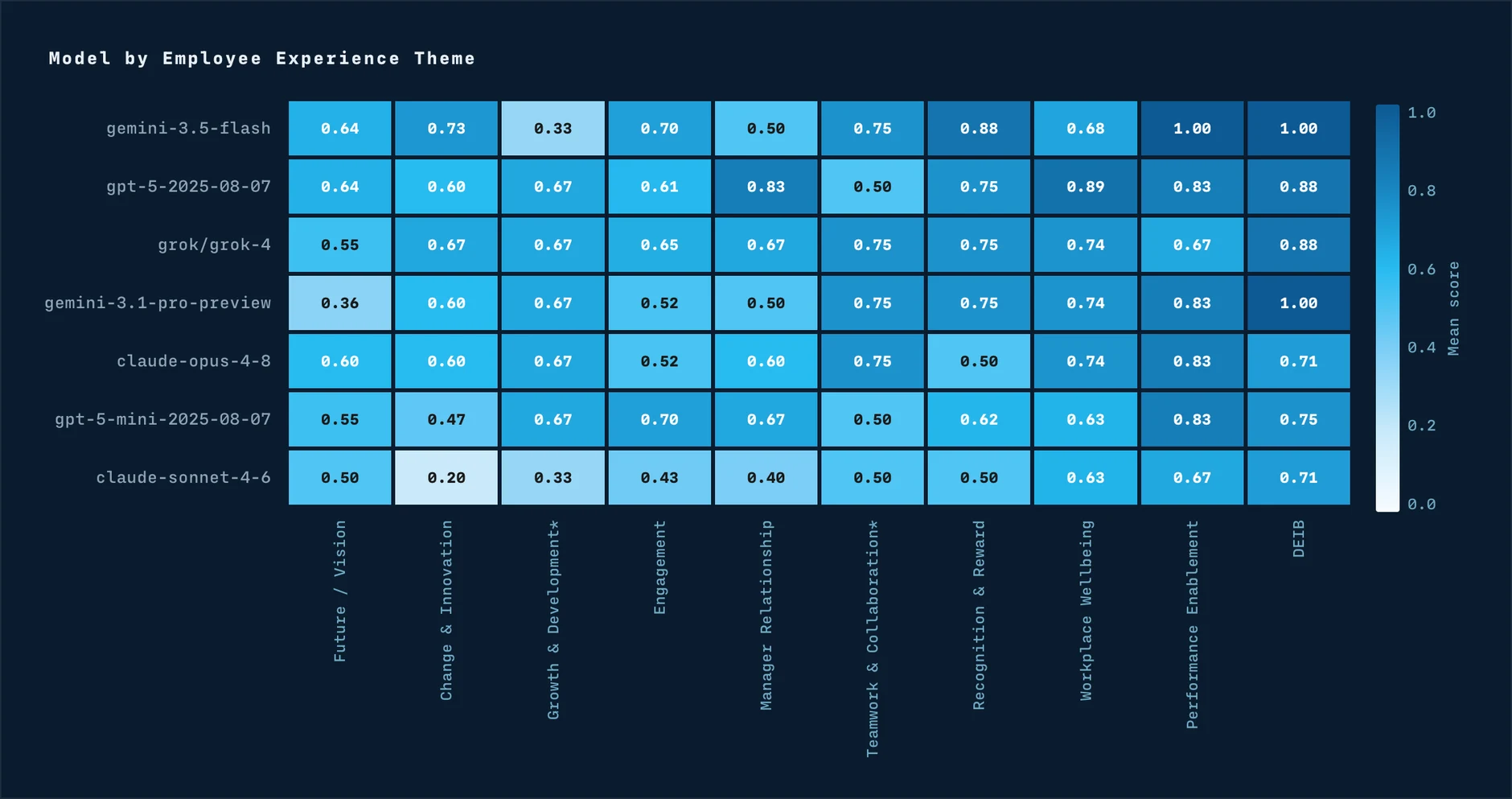
And there are real risks worth naming. The most common serious error across the 84 tasks wasn't a fabricated number — it was overclaiming: stating conclusions the underlying data didn't support. Most models did it a couple of times; one also fabricated a statistic outright. Rare, but serious — an overstated finding or an invented statistic can flow into real decisions before anyone independently checks them.
What This Actually Means for Leaders
The takeaway isn't "use AI" or "don't use AI." It's that frontier models are strong in some places and weak in others, and you need to know which is which.
That knowledge is what lets an organization deploy these tools responsibly — knowing where a model is reliable out of the box, and where it needs guardrails, better prompting, human review, or fine-tuning before it touches a real decision. And it's what lets the labs themselves improve.
We help frontier labs make their general models genuinely better at workplace tasks, and we help organizations understand exactly where to reinforce the models they're already using. Either way, AI gets better for the employee experience.
Why Perceptyx — and Why Now
At Perceptyx, our mission has always been to help organizations help their employees thrive at work. We do that every day through our products and our people. PYX Labs is the next evolution of that mission — except instead of focusing on our own software, we're working to make the AI models themselves better at understanding people.
That matters because everyone is using AI at work now, whether through our platform or straight from a frontier model. If we can help raise the quality and trustworthiness of that AI across the board, we're advancing the same goal we've pursued for twenty years: a better experience for the humans doing the work.
This Is Just the Beginning
This is benchmark number one. Employee listening is where we started because it's core to what we do — but we're already building toward coaching, development, and talent. Our ambition is a standard that spans every way employees and leaders rely on AI to understand and act on human behavior at work.
In every one of those areas, the work is subjective, nuanced, and consequential. It takes data, technical rigor, and the human practitioners who've spent their careers in the field. When all three are required, PYX Labs is the place to go.
If you're an AI lab looking to make your model genuinely good at workplace tasks, or an organization that wants to understand and improve the AI you already use — we'd like to talk. And if you want to dig into the methodology and full results behind the benchmark we released today, you can find them here.
The era of guessing how good AI is at understanding people is over. Let's measure it — and make it better, together.
PYX Labs is a research lab founded within Perceptyx, focused on defining evaluation standards and expert post-training for how AI systems interpret and reason about people in the workplace. The lab is advised by the Stanford Institute for Human-Centered AI (HAI) and UT Austin.